
Artificial Grass Drainage – Why Proper Preparation and Planning Matter
Good artificial grass drainage starts long before the grass is rolled out. The appearance of the finished lawn is important, but what sits underneath the surface often determines how well the installation performs after heavy rain.
A properly planned artificial lawn should allow water to move through the grass and into the prepared base below. If the groundwork, levels or drainage are wrong, problems such as standing water, slow drainage, unpleasant smells and soft areas can develop.
For this reason, drainage should always be considered as part of the preparation and planning stage of an artificial grass installation, not treated as an afterthought.
Whether the artificial lawn is being installed in a family garden, around a patio, in a pet-friendly garden or as part of a larger landscaping project, the drainage system needs to suit the individual site.
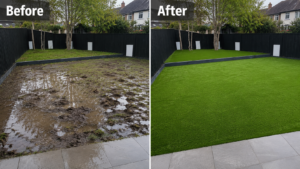
Why Artificial Grass Drainage Is Important
Artificial grass does not absorb rainwater like natural turf. Instead, water needs to pass through the grass backing and into the materials underneath.
Most quality artificial grass products are designed with drainage holes or a permeable backing that allows rainwater to pass through the surface.
However, the grass itself is only one part of the drainage system.
If water passes through the artificial turf but meets a poorly prepared or waterlogged base underneath, it has nowhere useful to go.
That is why a successful installation depends on several elements working together:
- Suitable artificial grass
- Correct excavation
- Properly prepared sub-base
- Effective laying course
- Appropriate falls and levels
- Existing soil conditions
- Additional drainage where required
Planning all these elements together helps create an artificial lawn that can cope with regular rainfall.
Drainage Starts With a Site Assessment
Before installing artificial grass, it is important to understand the existing garden.
Some gardens naturally drain well, while others remain wet for long periods after rain.
Heavy clay soil can behave very differently from sandy or free-draining ground. A garden that slopes towards the house may also require a different approach from one that naturally falls towards a suitable drainage area.
The planning stage should consider:
- Where water currently collects
- Existing garden levels
- Soil type
- Location of drains
- Patio and paving levels
- Door thresholds
- Garden walls
- Retaining structures
- Existing waterlogged areas
If a lawn already stays wet for several days after rainfall, simply covering it with artificial grass will not solve the underlying drainage problem.
The cause needs to be considered before the new surface is installed.
Correct Excavation Is Part of the Drainage Plan
Preparing the ground usually begins with removing the existing turf and a suitable depth of soil.
The exact excavation depth depends on the individual installation and materials being used.
This stage is important because it creates room for the new sub-base and laying materials.
Removing unsuitable organic soil also helps create a more stable foundation.
If artificial grass is installed over soft or poorly prepared ground, the finished surface may move or develop uneven areas.
Correct excavation allows the installer to construct the lawn from the ground up rather than simply placing artificial grass over existing conditions.
Building a Free-Draining Sub-Base
The sub-base is one of the most important elements beneath artificial grass.
Its purpose is to create a strong and stable foundation while allowing water to move through the installation.
Depending on the site, a suitable aggregate material may be installed and compacted in layers.
The material selected needs to provide both stability and drainage.
A poorly chosen or badly compacted base can cause several problems.
If it is too loose, the surface can move underfoot. If it is too dense or unsuitable for drainage, water may struggle to pass through.
The aim is to create a firm foundation that still allows moisture to move away appropriately.
Using Grano as Part of Artificial Grass Preparation
A finer laying layer is often installed above the main sub-base to create a smooth surface for the artificial grass.
Grano, sometimes referred to as granite dust or grano dust, is commonly used for this purpose.
When correctly compacted, grano can create a smooth and stable finishing layer beneath the grass.
It allows installers to establish accurate levels and remove bumps or depressions before the turf is fitted.
This is particularly important because small imperfections in the base may become visible through the finished artificial grass.
Grano should not be considered the entire drainage system on its own. It forms part of a correctly designed base construction.
The main sub-base, underlying soil and overall garden drainage still need to be appropriate.
Getting the Levels and Falls Right
An artificial lawn may look completely flat, but slight changes in level can make a significant difference to drainage.
Water naturally follows gravity, so the prepared base should be designed to encourage water to move in a suitable direction.
Where possible, water should be directed away from buildings and other sensitive areas.
The existing layout of the garden needs to be considered carefully.
For example, if an artificial lawn is being installed directly next to a patio, the new grass level needs to coordinate with the paving without creating a low point where water can collect.
Likewise, artificial grass installed next to the house needs to respect existing thresholds, air bricks and damp-proof courses.
Good planning helps prevent drainage problems from being created while solving others.
Dealing With Poorly Draining Gardens
Some gardens require more than a standard artificial grass base.
If the existing ground is particularly wet or slow draining, additional drainage measures may be needed.
This can include solutions such as:
- Additional excavation
- Greater depth of drainage aggregate
- Drainage channels
- Land drains
- Soakaway systems where appropriate
- Redirecting surface water
- Improving existing drainage routes
The right approach depends entirely on the garden.
There is no single drainage solution that should automatically be installed on every artificial lawn.
A relatively dry, free-draining garden may need little additional work, while a heavy clay site with existing standing water may require considerably more preparation.
Artificial Grass Drainage for Pet-Friendly Gardens
Drainage becomes even more important when artificial grass will be regularly used by dogs.
In a standard garden, drainage mainly needs to deal with rainwater.
In a dog-friendly artificial grass installation, urine also needs to pass through the surface and away from the lawn.
If liquid remains trapped beneath the grass, odour can develop.
This is why pet-friendly installations should be planned around both drainage and hygiene.
A permeable grass backing, suitable mineral-based groundwork and an effective drainage route can help reduce the amount of urine remaining close to the surface.
Regular cleaning is still necessary, but correct drainage makes ongoing maintenance considerably easier.
Preventing Puddles on Artificial Grass
Standing water is often a sign that something in the installation is not working correctly.
Possible causes can include:
- Low areas in the base
- Compacted or unsuitable ground
- Poor garden drainage
- Blocked drainage routes
- Incorrect levels
- Inadequate sub-base
- Water entering faster than the ground can absorb it
A small amount of surface water immediately after extreme rainfall does not necessarily mean there is a major problem, but persistent puddles should not be considered normal.
Careful preparation is the best way to prevent them.
The surface should be checked during installation to make sure there are no significant depressions where water can collect.
Drainage Around Patios and Paving
Artificial grass is often installed alongside patios, paths and other hard landscaping.
These areas need to be planned together because paving can significantly affect the way rainwater moves through a garden.
If a new patio sheds water directly onto the artificial lawn, the lawn may need to deal with much more water than rainfall alone.
Likewise, a paved area could block an existing drainage route.
For combined landscaping projects, it is best to establish the finished levels of both the paving and the artificial grass before construction begins.
This allows water movement to be considered across the whole garden.
Weed Membranes and Drainage
Weed membranes are often used as part of artificial grass installations, but the chosen product must be suitable for the location.
A membrane should help reduce weed growth without preventing water from moving through the system.
Placing an inappropriate impermeable material beneath the lawn can contribute to drainage issues.
The position of the membrane within the construction also matters.
Different installers and ground conditions may require different approaches, so the full base system should be considered rather than simply adding layers without understanding how they interact.
Why Proper Compaction Matters
Drainage does not mean the base should be loose.
The materials beneath artificial grass need to be compacted correctly so the surface remains stable when walked on.
A poorly compacted lawn may develop:
- Dips
- Uneven sections
- Movement
- Soft areas
- Visible depressions
Correct compaction creates a firm foundation while the use of appropriate materials allows water to continue moving through the base.
This balance between stability and permeability is one of the reasons good groundwork is so important.
Planning Drainage Before the Grass Is Installed
One of the biggest mistakes with artificial grass is focusing entirely on the finished product.
Customers naturally pay attention to pile height, colour, softness and appearance.
These things matter, but drainage and preparation should be discussed before choosing the final installation method.
Once artificial grass has been fitted, correcting a serious drainage problem can involve lifting the lawn and rebuilding part of the base.
It is much easier to identify and address potential problems during the initial preparation.
Artificial Grass Drainage in Wirral Gardens
For homeowners considering artificial grass in Wirral, drainage is particularly important because gardens across the North West regularly experience periods of heavy rainfall.
Every property is different.
A garden with artificial grass in Heswall may have completely different soil and levels from one in Wallasey, Bebington, Moreton or West Kirby.
The correct solution therefore begins with assessing the actual garden rather than applying the same base construction to every installation.
Existing water problems, paving, boundaries and soil conditions should all be considered before work begins.
Good Drainage Creates a Better Artificial Lawn
A successful artificial grass installation is built from the ground upwards.
The grass provides the visible finish, but excavation, sub-base preparation, grano, compaction, levels and drainage planning are what allow the lawn to perform properly.
Taking the time to assess the garden and prepare the base correctly can help prevent standing water, uneven areas and future maintenance problems.
For pet-friendly gardens, effective drainage also plays an important role in odour management and hygiene.
Artificial grass should never simply be treated as a covering for an existing lawn.
When drainage is considered as part of the complete preparation and planning process, the result is a cleaner, stronger and more practical outdoor surface designed to cope with everyday use and changing weather conditions.
